
Water Crisis in India: Can Our Cities Survive?
Water crisis is no longer a distant headline from drought hit villages. Instead, it is becoming a real urban sustainability challenge for cities like Bengaluru, Chennai, and Delhi.
At 25, I have grown up hearing that India has rivers and monsoons, so water shortage should never be our problem. However, tankers outside apartments and dry taps during summer tell a different story.
Because rapid urbanisation keeps expanding concrete spaces, groundwater levels are falling faster than we realise. Therefore, the conversation around sustainable cities is no longer optional but urgent.
Although we scroll through climate change posts daily, the water crisis hits differently when your society WhatsApp group starts discussing tanker timings. Consequently, the issue suddenly feels personal and not just environmental theory.
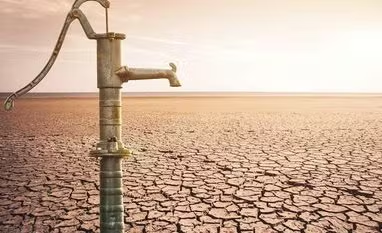
The Plot: How Our Cities Reached This Point
Firstly, every story has a beginning. In the early chapters of urban growth, cities expanded without thinking much about water management systems.
Meanwhile, lakes were encroached, wetlands were converted into real estate, and borewells became the quick fix. As a result, groundwater depletion quietly increased year after year.
Eventually, the conflict entered the scene when demand started exceeding supply. Because millions migrate to cities for education and jobs, the pressure on water infrastructure multiplies.
Then came unpredictable rainfall patterns due to climate change. Consequently, floods and droughts started happening in the same city within different months.
Now the climax feels close. While urban sustainability initiatives are rising, the pace often struggles to match the scale of the problem. Hence, the big question remains whether our cities can adapt fast enough.
Urban Sustainability and Sustainable Water Management
To begin with, urban sustainability is about designing cities that meet present needs without compromising the future. In simple terms, it means smart water management, waste reduction, and eco-friendly infrastructure.
Moreover, sustainable water management includes rainwater harvesting, wastewater recycling, and protecting natural water bodies. Because monsoons still bring huge volumes of water, the real issue is storage and distribution.
For instance, several apartments in Hyderabad have adopted rainwater harvesting systems. As a result, they reduce dependence on tankers and recharge groundwater.
Additionally, smart city projects aim to use technology for monitoring water leakage and consumption. Since data can reveal usage patterns, authorities can make better decisions.
However, implementation often faces bureaucratic delays and lack of awareness. Therefore, urban sustainability needs both policy action and citizen participation to truly work.
The Positives: Why There Is Still Hope
Thankfully, the situation is not all negative. Because awareness among youth is rising, conversations around water conservation are becoming mainstream.
Furthermore, startups are innovating in water purification, desalination, and recycling technologies. As a result, new career paths are emerging in environmental engineering and sustainability consulting.
Another positive aspect is community action. When residents collectively revive a local lake or implement rainwater harvesting, the impact becomes visible within a few years.
Moreover, educational institutions are integrating sustainability topics into their curriculum. Consequently, the next generation might grow up with stronger environmental responsibility.
Also, digital platforms amplify environmental campaigns quickly. Therefore, one viral video about a dying lake can spark city-wide discussions and action.
The Negatives: What Is Hard to Ignore
However, the water crisis also exposes uncomfortable realities. Because water access is unequal, poorer communities often suffer first and worst.
Meanwhile, luxury apartments may afford daily tankers, while nearby slums struggle for basic supply. As a result, water becomes not just an environmental issue but a social justice concern.
Additionally, over-extraction of groundwater continues despite regulations. Since enforcement is weak in many areas, illegal borewells operate quietly.
Another major challenge is public apathy. Although many people complain about shortages, fewer are willing to change consumption habits. Hence, long showers and wastage still happen without much thought.
Moreover, climate uncertainty makes planning difficult. When rainfall patterns shift unpredictably, traditional water storage systems sometimes fail to cope.
What Is Likable About the Sustainability Movement
Honestly, what feels inspiring is the youth-led climate movement. Because students and young professionals are speaking up, sustainability is no longer seen as a niche topic.
Additionally, sustainable urban design looks futuristic and practical at the same time. Green buildings, rooftop gardens, and recycled water systems create cities that feel modern yet responsible.
Another likable aspect is innovation. Since technology and environmental science intersect, solutions feel creative rather than restrictive.
Furthermore, social media campaigns make environmental activism accessible. Consequently, anyone with a phone can raise awareness or support a cause.
What Is Not So Attractive About the Reality
Still, let’s not romanticise the situation. Because large-scale change requires coordination between government bodies, progress can feel slow.
Moreover, sustainable infrastructure often demands high initial investment. As a result, some developers resist adopting eco-friendly systems.
Another concern is greenwashing. While some projects market themselves as sustainable, their actual environmental impact may be limited.
Additionally, lifestyle changes are uncomfortable. Since reducing water usage requires habit shifts, many people delay action.
Future of Water Security and Eco-Friendly Cities
Looking ahead, water security will define the quality of urban life in India. Because cities are economic hubs, their sustainability affects the entire country.
Therefore, investing in efficient water infrastructure, protecting lakes, and promoting conservation habits must become priorities.
Meanwhile, individual actions matter more than we think. When thousands of households adopt small conservation steps, the cumulative effect becomes powerful.
Ultimately, the water crisis is not just about scarcity. Rather, it is about how responsibly we design and live in our cities.
So instead of waiting for taps to run dry, we need to rethink our relationship with water today. In the long run, urban sustainability will decide whether our cities thrive or merely survive.